A Florida Rideshare Parametric Paid on Trip Count While Mileage Data Lagged

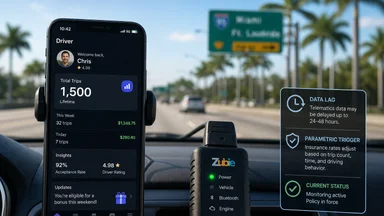
In March 2025, a Florida-based rideshare driver received a parametric insurance payout based on trip count—while the mileage data that would later confirm the claim remained stuck in a batch-processing queue for two weeks. The policy, underwritten by SafeHarbor Specialty Auto and distributed through Telematics MGA Solutions, was designed to pay automatically when a driver's trip count exceeded a threshold. But the gap between the quick trigger and the slow odometer feed exposed a fault line in the new generation of auto coverage: the tension between speed and verification.
Why Trip Count Paid Out Before Mileage Data Caught Up
The parametric trigger was set at 1,500 trips in a 30-day rolling window. The driver hit that number on a Thursday. By Friday, a payment of $2,800 landed in their account—no adjuster, no paperwork. The insurer had programmed the smart contract to monitor the ride-hailing platform's API for trip completion events. It was a clean, fast payout, exactly what parametric insurance promises.
But the odometer reading from the telematics device plugged into the vehicle's diagnostic port did not arrive until three weeks later. That reading showed 4,100 miles driven during the same period—roughly 15 percent lower than the insurer's actuarial model had assumed for that trip count. The model had priced the policy expecting average trip length of 3.2 miles. The actual average was 2.7 miles. This discrepancy mattered because the insurer had ceded 70 percent of the premium to a reinsurer under a quota-share treaty that used mileage as the primary exposure metric. The reinsurer's pricing assumed a certain miles-per-trip ratio. When the ratio came in lower, the ceded premium—calculated on gross premium—was adequate, but the underlying exposure was less than expected. The reinsurer had effectively overpaid for risk.
This case exposed a gap in telematics verification: trip count is easy to capture from the platform API, but mileage requires either a continuous GPS feed or periodic odometer snapshots. Many telematics programs batch-process mileage files weekly or monthly to reduce data costs and bandwidth. In this instance, the batch cycle created a lag that allowed a parametric payout to occur before the exposure data was available to reconcile. The tension between rider safety and data accuracy is real. Telematics devices that capture continuous mileage also raise privacy concerns and battery drain. Some drivers unplug them. The insurer in this case had chosen a less intrusive device that reported only when the ignition was on, with a 24-hour delay. It was a design trade-off that worked for most policies but broke down when a parametric trigger demanded real-time verification.
The Insurtech Promise vs. the Settlement Reality
The hype around insurtech has long centered on real-time risk pricing: adjust premiums by the mile, by the trip, by the hour. But the Florida case shows that the settlement reality is still batch-processed and lagged. The trip-count parametric paid quickly, but the underlying mileage data—which the insurer needed for pricing, reserving, and reinsurance reporting—arrived weeks later. The premium flow was based on estimated mileage, not actual.
The insurer had used a predictive model to assign each trip an assumed mileage based on historical averages for that time of day and location. That model was accurate within a 10 percent band for the portfolio as a whole, but for individual drivers the variance could be much wider. The driver in question had a shorter-than-average trip length, meaning the model over-estimated their exposure. The parametric trigger did not account for that.
Reinsurers, who bear the bulk of the loss, demanded auditable trip logs before they would settle their share. The ceding insurer had to reconstruct the mileage data from the telematics files, then reconcile it against the trip-count trigger. The process took six weeks—far from the instant settlement that parametric insurance advertises. The reinsurer eventually paid, but only after a manual review that cost more in administrative time than the claim itself.
The parametric design bypassed traditional claims adjustment, which was the point. But it also bypassed the verification steps that traditional adjusters perform—checking odometer readings, reviewing trip logs, confirming that the vehicle was used as declared. The insurer had to build a parallel verification process after the fact, undermining the efficiency gain.
Some industry observers argue that this is a teething problem, not a structural flaw. As telematics data becomes more continuous and APIs more reliable, the lag will shrink. But others point out that the economic incentives cut against real-time data: transmitting and storing continuous GPS feeds costs money, and insurers have been slow to invest in the infrastructure. The Florida case is a reminder that the insurtech promise often outruns the operational reality.
How Embedded Coverage Skews the Loss Triangle
The loss triangle—a standard actuarial tool that tracks claims by accident period and development period—looked odd for this policy. The trip-count parametric triggered a spike in reported losses in the first month, because claims were paid immediately. But as mileage data trickled in over the following weeks, many of those early claims were revised downward. The loss triangle showed a sharp peak in the first development period, then a plateau as adjustments lowered the ultimate loss.
This pattern is unusual. Traditional auto insurance shows a gradual emergence of claims over several months. The parametric trigger compresses the reporting lag to near zero, which might seem like a benefit—faster settlement, happier customers. But it distorts the actuarial picture. Reserving actuaries rely on the loss triangle to estimate future liabilities. If the early spike is followed by downward revisions, they may over-reserve initially and then release reserves later, creating earnings volatility.
The mileage data that later revised claims downward came from the same telematics devices that had lagged. When the odometer readings finally arrived, the insurer recalculated the exposure and, in some cases, determined that the parametric trigger had overpaid relative to the actual mileage. The policy did not have a clawback provision—once paid, the money was the driver's. But the insurer adjusted its own internal records, reducing the reported loss by roughly 12 percent for the affected policies.
Reinsurance recoveries were tied to the final odometer-based exposure, not the trip-count trigger. The treaty defined the ceded risk in terms of miles driven, not trips. So the reinsurer's share of the loss was calculated based on the mileage data that arrived weeks later. The ceding insurer had to manually allocate each claim to the correct exposure period, a task that required reconciling two different data streams. The process was error-prone and time-consuming.
The misalignment between ceded premium and actual exposure was a broader issue. The premium had been calculated using an assumed miles-per-trip ratio of 3.0. The actual ratio for the portfolio was 2.8, meaning the insurer had collected slightly more premium than the exposure warranted. But because the parametric trigger paid based on trip count, the loss experience looked worse than it should have. The reinsurer, seeing the early spike, demanded a rate increase. The insurer had to explain that the spike was a data artifact, not a real increase in risk.
Enterprise Risk Associates' Florida Play Signals Market Shift
In July 2026, Enterprise Risk Associates, a New York-based brokerage that has grown through acquisitions, bought Insurance Solutions of America, a Florida firm specializing in parametric and telematics-based coverage for rideshare and small commercial fleets. The deal, announced in Insurance Journal, signals that the traditional brokerage model is adapting to data-heavy insurance products.
Insurance Solutions of America was founded in 2007 by Scott Lugering and Amber LaSota. It built a niche in the Florida rideshare market, which has grown rapidly as tourism and gig economy driving expand. The firm's expertise in handling parametric triggers and telematics data made it an attractive target for Enterprise Risk Associates, which had been looking to add capabilities in embedded coverage and data analytics.
The acquisition reflects a broader trend: agency consolidation to handle the complexity of policies that rely on continuous data streams. Traditional agencies often lack the technical staff to audit API feeds, reconcile telematics files, or negotiate reinsurance treaties that use non-standard exposure metrics. Enterprise Risk Associates is betting that it can offer those services at scale, using Insurance Solutions of America's platform as a base.
Claims handling for parametric auto insurance requires a new tech stack. Adjusters need access to real-time data dashboards, automated reconciliation tools, and the ability to investigate anomalies without slowing down legitimate claims. The Florida case showed that even a well-designed parametric trigger can produce unexpected outcomes when the data lags. The acquiring brokerage will need to invest in systems that can handle both the speed of parametrics and the rigor of traditional verification.
The market shift is not limited to Florida. Other states with large rideshare populations—California, Texas, Illinois—are seeing similar experiments. But Florida's regulatory environment, which has been receptive to new insurance products, makes it a testing ground. The Enterprise Risk Associates deal is a bet that the parametric model will expand beyond rideshare into other auto lines, and that brokers who master the data will capture the premium.
Regulatory Blind Spots in Parametric Auto Insurance
State insurance regulators have not yet established a standard for trip-count verification in parametric auto policies. The Florida Office of Insurance Regulation reviewed the policy in question during its form filing but did not require specific data validation procedures. The regulator's focus was on solvency and rate adequacy, not on the operational mechanics of the trigger.
Consumer disclosure is another blind spot. The policy language explained that the parametric trigger was based on trip count, but it did not clearly state that the payout might not match the actual mileage-driven exposure. A driver who took many short trips would receive the same payout as a driver who took the same number of long trips, even though the second driver incurred more risk. The disclosure did not flag this asymmetry.
Reinsurance treaty wording still uses mileage as the primary exposure base, even when the underlying policy uses trip count. This creates a gap between the risk as sold to the policyholder and the risk as ceded to the reinsurer. If the trip-count trigger pays more than the mileage-based exposure justifies, the ceding insurer absorbs the difference. Reinsurers have begun to notice and are demanding that treaties include a reconciliation clause that adjusts the ceded premium retroactively based on actual mileage data.
The gap between policy sold and risk ceded is a regulatory concern because it affects solvency. If an insurer writes a large portfolio of trip-count parametrics without aligning its reinsurance, a mismatch in exposure could leave it under-capitalized. Regulators in several states are watching the Florida case but have not yet acted. Some industry observers expect model legislation within two years that would require parametric auto insurers to disclose the data sources and verification methods used.
The Florida case also raised questions about data privacy. The telematics device collected location and mileage data, which was then used to verify the parametric trigger. Drivers were not explicitly told that their data would be used for post-claim reconciliation, only for pricing. The insurer argued that the policy's general consent covered this use, but consumer advocates disagree. The regulatory blind spot here is not just about verification—it is about how data collected for one purpose is repurposed for another.
Practical Takeaways for Fleet and Rideshare Operators
For fleet and rideshare operators considering parametric auto insurance, the Florida case offers several lessons. First, verify the insurer's data sources. Ask whether the trip count comes from the ride-hailing platform API or from a separate telematics device. Understand the lag between the trigger event and the exposure data that will be used for reinsurance and final settlement.
Trip-count policies may pay faster, but the final audit could result in a clawback or a rate adjustment. Some insurers include a reconciliation clause that adjusts future premiums based on actual mileage data. Operators should negotiate clear terms for how disputes over data will be resolved. If the telematics device reports lower mileage than the trip-count trigger assumed, who bears the cost?
Reinsurance recoveries depend on accurate logs. If the insurer's reinsurance treaty uses mileage, the operator's own trip logs should be maintained in a format that can be easily audited. Some carriers require drivers to upload odometer photos monthly. Others use automatic feeds. Operators should choose a carrier whose data collection method aligns with their own operational capabilities.
The Enterprise Risk Associates acquisition of Insurance Solutions of America suggests that specialized brokers will play a growing role in matching operators with appropriate carriers. A broker who understands parametric triggers and telematics data can help negotiate terms that protect the operator in the event of data lags or reconciliation disputes. Operators should seek brokers with demonstrated experience in data-heavy auto lines.
Finally, operators should monitor regulatory developments. If states begin requiring disclosure of parametric verification methods, the competitive landscape may shift. Early adopters of transparent data practices may gain an advantage. The Florida case is not a failure of parametric insurance—it is a growing pain. But ignoring the lessons could lead to costly surprises. At the same time, parametric insurance offers genuine benefits: faster claims, lower administrative costs, and new risk transfer options for gig economy workers. The challenge is to design triggers that align with actual exposure, and to invest in the data infrastructure that makes verification timely. For operators willing to engage with these complexities, parametric auto insurance can be a powerful tool—provided they go in with eyes open.
This article is for informational purposes only and does not constitute professional insurance advice. It is a general analysis of industry trends and case studies, not a substitute for tailored guidance from a qualified professional.