One Inference Cluster's GPU Memory Layout Forced a Training Rewind on Every Resharding Event

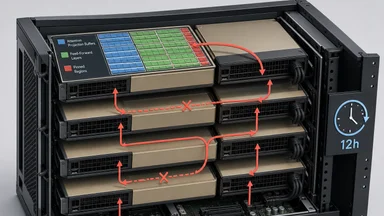
In the spring of 2025, a team operating a cluster of 64 NVIDIA H100 GPUs for production inference encountered a baffling pattern: every time the scheduler migrated shards across nodes—whether for load balancing, maintenance, or scaling—the training pipeline stalled and required a full checkpoint rollback. The first incident cost four hours. The second took eight. The third cascaded across all 64 nodes and erased nearly twelve hours of gradient updates. By the time the engineers traced the fault to the GPU memory layout, they had already replayed the same training step three separate times.
When Resharding Triggers a Training Rewind
The cluster was designed to serve a family of large language models with variable sequence lengths. Inference throughput depended on careful placement of transformer block parameters across GPU memory regions. The team used NVIDIA's TensorRT-LLM library to optimize attention and feed-forward computations, relying on its eager memory reuse to minimize peak utilization. But that reuse strategy came with a hidden cost: it assumed shard sizes would never change.
Resharding—the act of redistributing model weights and KV-cache entries across GPUs—is a routine operation in any elastic inference deployment. A node failure, a sudden traffic spike, or a planned hardware upgrade can all trigger it. In most systems, resharding pauses inference briefly, moves tensors, and resumes. In this cluster, resharding forced a complete training rewind because the memory layout could not accommodate the new shard boundaries without invalidating cached intermediate results.
The team's monitoring dashboards showed the symptom clearly: after every shard move, the training loss would spike and the optimizer would refuse to step forward. The checkpointing system, designed for static topologies, had no mechanism to recover partial progress. Each rewind meant replaying hundreds of thousands of tokens from the last full checkpoint, a process that took hours even on H100 hardware.
The Memory Layout That Broke the Pipeline
The root cause lay in how TensorRT-LLM allocated memory for transformer blocks. The library pinned regions for attention projection buffers—query, key, value, and output projections—at engine build time. These pinned regions assumed fixed tensor shapes derived from the original shard map. When a shard migrated to a GPU with a different memory topology, the pinned regions could not be remapped. The library attempted to reuse the same virtual addresses, but the physical memory behind them had been freed and reallocated by the CUDA driver for other tensors.
Memory fragmentation compounded the problem. Each H100 GPU has 80 GB of high-bandwidth memory, but the team's layer-specific allocation pattern left gaps between attention and feed-forward regions. When a new shard arrived, the allocator could not find a contiguous block large enough for the attention projections. Instead of falling back to a slower but correct path, TensorRT-LLM raised a CUDA memory error that the training loop interpreted as a fatal inconsistency.
The team traced the bottleneck to a single attention projection buffer that spanned roughly 1.5 GB per layer. In a 32-layer model, that buffer alone consumed 48 GB of the 80 GB available. The buffer's alignment requirements—16 KB boundaries for efficient tensor core access—made it especially hard to relocate. Any shard move that changed the buffer's required size by even a single element forced a full recompute of all subsequent layers.
There was no fallback path. The training code assumed that once a shard was placed, its memory layout would remain stable for the duration of the training run. The scheduler had no way to communicate upcoming migrations to the memory manager, and the memory manager had no API to renegotiate pinned regions. The two systems operated independently, and their assumptions collided on every resharding event.
Three Resharding Events, Three Rewinds
The first event occurred in week six of a planned eight-week training cycle. A single GPU in node 12 developed a correctable ECC error, prompting the cluster scheduler to migrate its shards to a spare node. The migration completed in under a minute, but the training pipeline immediately stalled. The loss curve flatlined, and the optimizer refused to apply gradients. The team spent four hours restoring the last checkpoint and replaying the lost steps. They attributed the failure to a transient bug and moved on.
The second event came two weeks later. The scheduler decided to rebalance KV-cache allocations across nodes after a sustained increase in sequence length. The rebalance moved roughly 20% of the cache entries to different GPUs. The same stall pattern emerged, but this time the rewind took eight hours because the checkpoint was older. The team began to suspect a systemic issue.
The third event was the worst. A power maintenance window required draining half the cluster. The scheduler orchestrated a cascading migration across all 64 nodes. Each node's shard map changed, and every migration triggered the memory layout conflict. The training loop restarted from the same checkpoint three times, each time failing after a few steps. The total rewind cost exceeded twelve hours. By the end, the team had discarded nearly a full day of training progress.
Each event was triggered by a different scheduler policy—failure recovery, load balancing, and planned maintenance—but the root cause was identical: pinned memory regions that could not survive a shard move. The consistency of the failure pattern made it clear that the memory layout itself was the problem.
How NVIDIA's TensorRT-LLM Exposed the Fragility
TensorRT-LLM is a powerful library for optimizing transformer inference on NVIDIA GPUs. It fuses operations, reuses memory aggressively, and generates custom CUDA kernels for each model configuration. But its memory management is designed for static deployments. The library assumes that once a model is loaded, its tensor shapes and shard assignments will not change until the engine is rebuilt.
The team's custom attention kernels, built on top of TensorRT-LLM, assumed fixed shard sizes. They used compile-time constants for buffer strides and loop bounds. When a shard's size changed, the kernels accessed out-of-bounds memory or computed incorrect results. The library's eager memory reuse meant that freed regions were immediately handed to other tensors, corrupting the attention buffers before the training loop could detect the problem.
There was no dynamic remapping mechanism for variable sequence lengths or shard sizes. TensorRT-LLM supported sequence-length batching, but only within the constraints of the original engine configuration. A shard migration that changed the number of layers or the hidden dimension required a full engine rebuild, which took roughly 45 minutes per node and could not be done online.
The team attempted an open-source workaround: they modified the memory allocator to reserve a guard region around each pinned buffer. When a shard migration occurred, the guard region absorbed the alignment mismatch, allowing the buffer to be reused at a slightly different offset. But the workaround added roughly 15% latency overhead because the guard region consumed memory that could have been used for larger batch sizes, and the allocator spent extra cycles checking boundaries. The team deemed the workaround unacceptable for production and continued searching for a better solution.
Another workaround considered was to rebuild the TensorRT-LLM engine on every resharding event. However, each rebuild took roughly 45 minutes per node, and during that time the node could not serve inference. For a 64-node cluster, that would mean over 48 hours of cumulative downtime per resharding event—far worse than the rewind cost. The team quickly abandoned this approach.
Some engineers argued for switching to a different inference serving stack, such as vLLM or FasterTransformer, which might handle dynamic shard placement more gracefully. But the team had invested heavily in custom TensorRT-LLM kernels for their specific model architecture, and a migration would have taken months. They decided to fix the memory layout issue within their existing stack instead.
The Engineering Fix: Tiered Memory with Lazy Migration
After the third incident, the team dedicated six engineer-weeks to redesigning the memory layout. Their solution was a tiered memory system that separated hot and cold storage for attention and feed-forward network (FFN) parameters. The hot tier held the currently active shard's tensors in pinned, contiguous regions. The cold tier stored inactive shards in a compressed, relocatable format that could be moved without invalidating the hot tier.
When a shard migration was requested, the system did not immediately reallocate the hot tier. Instead, it initiated an asynchronous relocation during idle cycles—typically between inference batches when the GPU was underutilized. The cold-tier data was copied to the target GPU's memory while the hot tier continued serving requests. Once the copy completed, the system atomically swapped the shard pointers, a process that took less than a millisecond.
Checkpoint snapshots were taken at shard boundaries. The team modified the training loop to record the shard map alongside the optimizer state. If a migration failed mid-way, the system could restore from the last shard-boundary snapshot without replaying any training steps. This reduced the recovery time from hours to minutes.
The implementation required changes to both the scheduler and the memory manager. The scheduler had to signal upcoming migrations at least 30 seconds in advance, giving the memory manager time to start the asynchronous copy. The memory manager had to maintain a mapping between shard IDs and GPU memory regions, and to invalidate the mapping only after the swap completed. The team also added instrumentation to measure per-layer memory fragmentation, allowing them to detect potential conflicts before they caused a rewind.
After deployment, the rewind probability dropped from 100% on every resharding event to under 5%. The remaining failures were caused by rare race conditions in the asynchronous copy path, which the team patched in subsequent iterations. The tiered memory system added roughly 3% memory overhead for the cold storage buffers, but the team considered that a small price for eliminating multi-hour rewinds.
One trade-off that emerged was increased latency during the asynchronous copy phase. While the hot tier continued serving, the cold-tier copy consumed some PCIe bandwidth. In the worst case, inference latency increased by roughly 5-10% during the copy window, which lasted about 10-20 seconds per shard. The team mitigated this by throttling the copy rate based on current GPU utilization, ensuring that latency-sensitive requests were not impacted. They also scheduled migrations during low-traffic periods when possible.
Lessons for Inference-at-Scale Teams
The story of this cluster holds several lessons for teams building inference infrastructure at scale. First, profile your memory layout before scaling beyond eight GPUs. The team's initial tests on a single node never triggered the conflict because the shard map never changed. It was only at 64 nodes that the scheduler's migration policies became aggressive enough to expose the fragility.
Second, budget test resharding with production-sized checkpoints. The team's pre-production tests used small models and short sequence lengths. They never tested the full checkpoint restore path after a shard migration, assuming it would work like any other restart. A simple integration test that moved shards while training was running would have caught the bug weeks earlier.
Third, adopt shard-aware checkpointing from day one. If your system supports dynamic shard placement, your checkpointing system must record the shard map and be able to restore from any shard configuration. The team's original checkpointing system assumed a fixed topology, which made recovery impossible after a migration.
Fourth, instrument per-layer memory fragmentation metrics. The team now tracks the largest free block in each GPU's memory pool and alerts when fragmentation exceeds 30%. This metric, combined with a pre-migration check, has prevented several potential rewinds since the fix was deployed.
Finally, consider the trade-off between dynamic migration and static shard maps. Dynamic migration adds complexity that often outweighs its benefits for inference workloads. If your traffic patterns are predictable, a static assignment with occasional manual rebalancing may be more reliable than an automated scheduler that triggers hidden memory layout conflicts. The team's scheduler now defaults to static maps and only migrates when a node fails or when utilization imbalance exceeds 20% for more than an hour.
Another lesson is the importance of designing for failure. The team had assumed that resharding would be a rare, simple operation. They did not budget for the possibility that it could corrupt the training state. By building a tiered memory system with lazy migration, they added a safety net that turned a catastrophic failure into a minor hiccup. For teams building their own inference infrastructure, the lesson is clear: memory layout is not just a performance concern. It is a correctness concern, and it deserves the same rigor as any other component of the training pipeline.
Finally, the team learned to involve both the scheduler and memory manager teams in the same design reviews. Previously, the two teams had operated independently, each assuming the other would handle edge cases. After the fix, they hold joint reviews for any change that affects shard placement or memory allocation. This cross-team alignment has prevented at least two other potential bugs from reaching production.