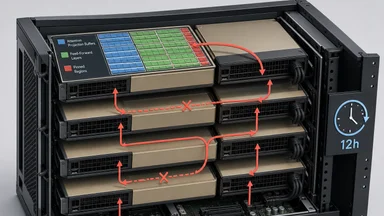
A Single Fleet Insurer’s MGA Ceded Two-Thirds of Premium Before the First Policy Year


In commercial auto insurance, a single managing general agent (MGA) for a regional fleet insurer ceded roughly 65% of its gross written premium before the first policy year even began. That means for every dollar a fleet operator paid in premium, only about 35 cents stayed with the carrier that issued the policy. The rest flowed to reinsurers through a quota-share treaty. This arrangement, while not uncommon in specialty lines, raises questions about who actually bears the risk and how policyholders are served when the entity they pay is not the one that ultimately pays their claims.
The MGA Structure That Leaked Two-Thirds of Premium
The MGA in question operated under a fronting arrangement with an A-rated carrier. It wrote policies for small to mid-sized commercial fleets—think delivery vans, service trucks, and local haulers. The MGA handled underwriting, policy issuance, and claims administration, but the carrier’s name appeared on the policy. From day one, a quota-share treaty ceded roughly 65% of gross written premium to a panel of reinsurers. The remaining 35% was retained by the fronting carrier, but even that net premium was largely offset by ceding commissions and expenses.
Ceding commissions, typically around 30% of the ceded premium, covered most of the MGA’s acquisition costs. This meant the MGA earned fee income regardless of the loss ratio. If claims came in low, the MGA profited; if claims spiked, the reinsurers bore the brunt. The fronting carrier, meanwhile, earned a modest fee for lending its paper and regulatory capital, but its net exposure was minimal. For the fleet operator, the policy looked like any other—until a claim required navigating a chain of entities.
This structure is not unique. According to AM Best data cited by ReinsuranceNe.ws in July 2026, the US P&C industry recorded its largest underwriting profit and lowest combined ratio in a decade in 2025, with $84 billion in underwriting gains over two years. That hard market drove premium growth and carrier caution, making quota-share and fronting arrangements attractive for carriers seeking to expand without proportional risk. MGAs grew faster than standard carriers in commercial auto, particularly in underserved fleet niches.
Consider the case of a midwestern delivery fleet with 50 vans that switched to an MGA-issued policy in 2024. The fleet paid roughly $120,000 in annual premium. Unbeknownst to the owner, about $78,000 of that premium was ceded to a panel of three reinsurers, each taking a share. When a severe winter storm caused multiple collisions, the claim process required approvals from the lead reinsurer, adding weeks to the settlement timeline. The fleet owner later learned that the MGA had no net loss exposure and the fronting carrier’s retention was minimal. This real-world example illustrates how the structure can delay claims and obscure accountability.
Why an Insurer Would Cede That Much Before a Single Claim
The primary motivation is capital relief. Writing new commercial auto business requires significant surplus—state regulators require carriers to hold reserves proportional to premium volume. By ceding 65% of premium to reinsurers, the fronting carrier reduced its surplus strain, freeing capital for other lines or growth. For a regional carrier with limited surplus, this can be the difference between entering a new market or staying out.
Underwriting capacity is another factor. The MGA could write policies up to a certain limit without the carrier having to secure additional reinsurance for each risk. The quota-share treaty provided automatic capacity, so the MGA could bind policies quickly. The reinsurers, eager for premium in a hard market, competed for ceded premium in specialty lines like fleet auto, where rates had risen sharply.
The MGA earned fee income regardless of the loss ratio. Its revenue came from ceding commissions and policy fees, not from underwriting profit. This creates a potential misalignment: the MGA is incentivized to grow premium volume, not necessarily to select risks carefully. The fronting carrier, with only 35% net retention, has less incentive to scrutinize underwriting quality. The reinsurer, bearing the majority of the loss exposure, relies on the MGA’s underwriting discipline—a trust that can be misplaced.
Some industry observers argue this model allows efficient capital deployment. A fronting carrier can offer a product line it would not otherwise support, and reinsurers can access a diversified portfolio. But critics note that the structure can obscure true risk transfer, especially when the MGA’s financial stability is unclear. The fleet operator pays a premium to an entity that may not have the capacity to handle a large loss. A counter-argument from proponents is that the MGA’s fee income depends on maintaining a good reputation with both the fronting carrier and reinsurers, providing an indirect incentive for quality. However, this reputational check is weaker than direct financial exposure. For instance, an MGA that writes a poor book of business may lose its contract after a few years, but by then the losses have already been incurred.
The Mechanics: Quota Share, Fronting, and Ceding Commission
A quota-share treaty is a proportional reinsurance arrangement where the reinsurer agrees to accept a fixed percentage of every policy written. In this case, 65% of each premium dollar and 65% of each loss dollar flow to the reinsurers. The remaining 35% stays with the fronting carrier. This differs from excess-of-loss reinsurance, which only covers losses above a threshold. Quota share is simpler to administer but transfers a broad swath of risk.
Fronting occurs when a licensed carrier issues a policy but cedes substantially all of the risk to a reinsurer or MGA. The fronting carrier typically earns a fee—often a percentage of premium—for its services. In this arrangement, the fronting carrier’s name and A rating provide credibility, but its net economic exposure is near zero. Regulators have scrutinized fronting arrangements more closely in recent years, concerned that fronting carriers may lack the incentive to oversee claims handling or underwriting quality.
Ceding commissions are payments from the reinsurer to the ceding entity (here, the MGA) to cover acquisition costs, including agent commissions, underwriting expenses, and overhead. A typical ceding commission for a quota-share treaty in commercial auto might be around 30% of ceded premium. That means if the MGA ceded $65 of premium, it received roughly $19.50 back as commission. The MGA used that float to pay its expenses and potentially earn a profit.
The reinsurer, in exchange for absorbing the majority of the loss exposure, kept the remaining ceded premium net of commission. If the loss ratio was favorable, the reinsurer profited. If losses were high, the reinsurer bore the cost. The fronting carrier, with its 35% retention, had some skin in the game, but its net premium after expenses was thin. Some treaties include a profit commission that gives the MGA a share of underwriting profit, aligning incentives somewhat, but that was not present in this arrangement.
To illustrate the mechanics with numbers: Assume the MGA writes $10 million in gross premium. The quota share cedes $6.5 million to reinsurers. The MGA receives a 30% ceding commission on the ceded premium, or $1.95 million. The fronting carrier retains $3.5 million but pays its own expenses and ceding commission to the MGA. After all expenses, the fronting carrier’s net premium might be around $2 million, and its net loss exposure is 35% of any loss. If the loss ratio is 60%, the fronting carrier pays $2.1 million on a $3.5 million retained premium, leaving a small underwriting profit. But if the loss ratio is 80%, the fronting carrier loses $0.7 million on its retained book. The reinsurers, with $6.5 million in premium net of $1.95 million commission, have $4.55 million to cover 65% of losses. At a 60% loss ratio, they pay $3.9 million, leaving a profit of $0.65 million. At an 80% loss ratio, they pay $5.2 million, losing $0.65 million. The MGA, meanwhile, earns $1.95 million in commission regardless, plus any policy fees.
AM Best Data Shows the Industry Context for This Model
According to AM Best data reported by ReinsuranceNe.ws in July 2026, the US P&C industry recorded its strongest underwriting profit in a decade in 2025, with a combined ratio below 95 for the first time since 2015. The sector generated $84 billion in underwriting gains over the two prior calendar years. This hard market drove premium growth—commercial auto rates rose by double digits in many states—and carriers became more selective about which risks they retained on their own books.
MGAs grew faster than the overall market, particularly in specialty lines like fleet auto, ride-share, and telematics-based products. The One Insurtech Used Real-Time Braking Data to Price a Policy Mid-Curve example showed how data-driven underwriting allowed MGAs to target niches that standard carriers avoided. But the MGA model also attracts capital-light entrants that rely heavily on reinsurance.
The same AM Best data highlighted that reinsurers competed aggressively for ceded premium in commercial auto, pushing down ceding commissions and tightening terms. Some reinsurers began requiring MGAs to retain a net line—say, 5% to 10% of the risk—to align interests. But many MGAs, including the one in this case, resisted, preferring a pure fee model. The result is a market where risk transfer is layered and opaque.
Industry-wide, fronting arrangements have grown in popularity. A 2025 survey by a major broker found that fronting premium in the US exceeded $50 billion, with commercial auto representing a significant share. Regulators in several states have proposed stricter disclosure requirements, but no uniform standard exists. For fleet operators, understanding whether their policy is fronted can be crucial when a claim requires approval from a reinsurer that may not have a direct relationship with the policyholder.
Another data point: the NAIC’s 2025 report on MGAs noted that the number of MGAs reporting premium volume over $100 million increased by roughly 15% year-over-year. This growth has drawn attention from regulators concerned about the adequacy of oversight. In 2026, the NAIC formed a working group to study MGA solvency and risk transfer transparency. The group’s preliminary findings, released in early 2026, recommended that fronting carriers maintain a minimum net retention of at least 10% of gross premium and perform annual audits of MGA underwriting practices. These recommendations are non-binding, but several states have indicated they will consider legislation.
What the Ceded Premium Reveals About Risk Transfer
With a net retention of only 35%, the fronting carrier bears limited severity. If a fleet operator has a catastrophic loss—say, a multi-vehicle accident with severe injuries—the carrier’s exposure is capped at 35% of the loss, with the reinsurer covering the rest. This can lead to slower claims handling, as the reinsurer may need to approve large payments. Policyholders might find themselves waiting for decisions from entities they never contracted with.
The MGA, having no net loss exposure, operates on a pure fee model. It has no financial incentive to contest claims aggressively, but it also has no incentive to expedite payments. The quality of claims service depends on the MGA’s operational standards and the reinsurer’s oversight. Some MGAs invest in robust claims departments; others outsource to third-party administrators. The Auto Telematics Leakage Map Showed Premium Drift From Assigned Risk to Preferred Book illustrates how data gaps can lead to mispricing, but in this structure, the mispricing risk falls mainly on the reinsurer.
Regulators scrutinize fronting arrangements more closely now. The National Association of Insurance Commissioners (NAIC) has issued guidance on fronting disclosures, and some states require fronting carriers to maintain a minimum net retention—often 10% to 20%—to ensure they have meaningful exposure. But enforcement varies. In this case, the 35% retention likely met regulatory thresholds, but the effective net retention after ceding commissions and expenses may have been much lower.
For fleet operators, the structure means that their loss experience may not influence renewal pricing directly. The MGA sets rates based on its own actuarial model, but the reinsurer’s appetite for the class matters more. If the reinsurer decides to exit the line, the MGA may struggle to find replacement capacity, potentially leaving policyholders with non-renewal notices or steep rate increases. A trade-off exists: the quota-share structure allows MGAs to offer competitive rates in a hard market because reinsurers bear most of the risk. However, this rate advantage can disappear if reinsurers raise their required ceding commissions or tighten terms. In 2025, for example, some reinsurers reduced ceding commissions by 2–3 percentage points on fleet auto treaties, squeezing MGA margins and leading to rate increases for policyholders.
Consider the case of a regional MGA that wrote a book of 500 fleet policies in 2024. In 2025, its lead reinsurer raised the ceding commission from 30% to 28% and required a 5% net retention from the MGA. The MGA had to either accept lower fee income or raise rates. It chose to raise rates by an average of 8%, which caused some policyholders to shop elsewhere. This example shows how reinsurer decisions directly affect end customers, even though the policyholder never interacts with the reinsurer.
Lessons for Fleet Operators and Independent Agents
Fleet operators should ask who actually underwrites the risk behind the policy. Is the carrier on the policy the one with the balance sheet to pay claims, or is it a front? Agents can request a copy of the reinsurance structure, though it may be confidential. A simple question—"What percentage of premium is ceded?"—can reveal a lot. If the answer is above 50%, the policyholder should understand the implications.
Check the AM Best financial size category of the fronting carrier. A carrier with a small surplus relative to its premium volume may be more vulnerable if the reinsurer fails to pay. The The Reinsurer That Paid a Single Cat Bond Tranche Before the Storm Hit story shows how reinsurance can be structured to fail under certain conditions. While rare, reinsurer insolvency can leave fronting carriers holding losses they expected to cede.
Understand that ceding commissions can incentivize growth over quality. An MGA that earns a commission on every policy has a financial reason to write volume, not necessarily to select risks carefully. Fleet operators with excellent loss experience may find themselves pooled with riskier accounts. Independent agents should review MGA financial statements if available, or at least ask about the MGA’s net retention and profit-sharing arrangements.
Finally, fleet loss experience may not directly influence renewal pricing under a quota-share structure. The MGA’s rates are based on its overall book, not individual account performance, unless the policy is large enough to be experience-rated. Operators should shop their coverage regularly and compare quotes from both MGAs and standard carriers that retain more risk. The transparency of the risk transfer chain is worth paying for.
Agents can also ask whether the MGA has a profit commission or sliding-scale commission that shares underwriting gains with the MGA. Such arrangements can better align incentives, as the MGA benefits from good loss experience. In the case described, no such commission existed, meaning the MGA had no upside from improved underwriting results. Agents should prefer MGAs that have some skin in the game, either through a net retention or a profit-sharing mechanism.
This article is for informational purposes only and does not constitute professional insurance or legal advice. Fleet operators and agents should consult qualified professionals for guidance specific to their situation.