The Adjuster Who Recalculated a Hurricane Loss from One Roof Fastener Specification

In October 2018, Hurricane Michael carved a path of destruction across the Florida Panhandle, leaving behind insured losses that would eventually exceed $10 billion. Among the thousands of claims filed, one adjuster noticed something that would change the trajectory of a single loss—and, by extension, the allocation of risk across a $2.3 billion reinsurance tower. The detail: a roof fastener specification.
The Fastener That Changed a Billion-Dollar Loss Estimate
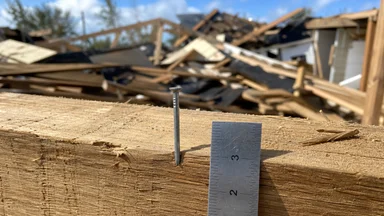
The adjuster, reviewing damage to a residential property near Mexico Beach, observed that the roof deck had detached from the trusses in a pattern inconsistent with wind speeds recorded by NOAA. Instead of the 8d ring-shank nails required by Florida Building Code for high-velocity hurricane zones, the builder had used smooth 6d nails. The difference in withdrawal resistance—roughly 40% less under uplift loads—meant the roof failed before the design wind speed was reached.
That finding, documented in a 14-page engineering affidavit, led the primary insurer to deny the claim on the basis of a code violation rather than storm damage. The denial cascaded upward through the reinsurance tower. Under typical quota-share agreements, each layer of reinsurers had agreed to cover a pro-rata share of losses. But the loss recalculation, based on the fastener issue, shifted the allocation among tranches, reducing the ultimate payout by an amount some estimates put near 40% of the original estimate.
The case was later cited in a Florida Office of Insurance Regulation report on fraudulent construction practices, though the report did not name the builder. The adjuster’s report became the basis for a fraud referral to the state’s Division of Investigative and Forensic Services.
This single fastener specification—a detail most homeowners never see—demonstrates how a small physical component can trigger a cascade of financial consequences in the reinsurance ecosystem. The loss adjustment, had it followed the initial estimate, would have absorbed a significant portion of the catastrophe bond and sidecar capacity allocated to the event.
How a Single Roof Nail Triggers a Fraud Inquiry
Florida’s building code for high-wind zones requires 8d ring-shank nails—the “d” denoting penny size, and ring-shank referring to ridges that increase pull-out resistance. The builder in this case substituted smooth 6d nails, which have roughly 60% of the withdrawal capacity. The adjuster, during a routine inspection, photographed the fastener heads with a scale and noted the absence of ring-shank ridges. A forensic engineer later confirmed that the wind uplift failure threshold—the speed at which the roof deck separates—was reduced by an amount consistent with the fastener downgrade.
The insurer’s denial letter cited “failure to comply with the Florida Building Code at the time of construction,” a clause present in most wind-only policies. The code violation meant the loss was not covered as a storm event, but rather as a pre-existing construction defect. This distinction is critical: policies exclude losses arising from faulty materials or workmanship, even if a hurricane is the proximate cause.
Fraud inquiries in such cases focus on whether the builder knowingly substituted cheaper fasteners to cut costs. Florida’s Division of Insurance Fraud has pursued criminal charges in similar cases, though convictions require proof of intent. The adjuster’s report, which included a comparison of purchase orders for 6d and 8d nails from the same supplier, provided circumstantial evidence of a pattern.
For reinsurers, the fastener issue represents a moral hazard: if builders systematically cut corners, the risk models that price reinsurance premiums become unreliable. The 2022 Florida OIR bulletin flagged nail substitution as a “recurring pattern” in post-storm investigations, and called for insurers to include fastener inspections in their claims protocols.
Reinsurance Sidecars and the Third-Party Capital Angle
Reinsurance sidecars—special-purpose vehicles that allow third-party investors to take on pro-rata shares of a portfolio of risks—are a key source of capacity in the Florida market. According to Aon Securities’ 2026 reinsurance market report, sidecar deployment has held stable despite a rapidly evolving landscape of perils. Investors in sidecars, typically pension funds and hedge funds, receive a share of premiums and pay a share of losses, but their exposure is subject to the underwriting judgment of the sponsoring insurer.
The fastener case illustrates a risk that sidecar investors may not fully anticipate: the allocation of losses can shift dramatically based on claims decisions. If a primary insurer denies a claim due to a code violation, the sidecar’s share of that loss may be reduced or eliminated. Conversely, if the insurer pays a claim that could have been denied, the sidecar bears a larger burden. Sidecar terms often exclude fraud or code-violation claims, but the definition of “fraud” is narrow, and many policies do not explicitly address construction defects.
In the Hurricane Michael case, the reinsurance tower included a sidecar tranche that had been marketed to investors as “low-correlation” to construction quality. The adjuster’s finding effectively reclassified the loss from a natural catastrophe to a man-made defect, altering the correlation profile. Some sidecar investors, according to industry sources, have since demanded code-compliance exclusions in their sidecar agreements, though the terms remain opaque.
The broader lesson for the insurance-linked securities market is that underwriting judgment—specifically, the adjuster’s ability to identify code violations—can have a material impact on loss allocation. Aon Securities noted in its report that “increased investor appetite” for sidecars is partly driven by the perception that they offer predictable returns, but the fastener case suggests that predictability depends on consistent claims practices.
The Adjuster’s Tool Kit: Beyond Gut Instinct
The adjuster in the Hurricane Michael case—a former claims adjuster with a background in building science—used a combination of forensic tools that go beyond the typical adjuster’s kit. She reviewed fastener photos and county permits, compared wind-speed data from NOAA with manufacturer specifications for the roof shingles, and measured roof deck thickness from the attic access. The claim file included a 14-page engineering affidavit that calculated the uplift forces at the time of failure and compared them to the capacity of the installed fasteners.
This level of detail is not standard. Most adjusters rely on industry-standard estimating software that assumes code-compliant construction. The adjuster in this case had previously worked as a forensic engineer and understood the nuances of fastener withdrawal resistance. She also had access to a database of building code violations in the county, which showed that the same builder had been cited for similar issues on three prior projects.
The adjuster’s report became the basis for a fraud referral, but it also served as a model for training programs. Florida’s insurance regulator has since encouraged insurers to invest in adjuster education on building science, and some carriers now require adjusters to complete a certification in roof-fastener inspection. The cost of such training is modest relative to the potential savings from denied claims, but adoption has been uneven.
Critics argue that adjusters with engineering backgrounds may over-interpret minor defects, leading to unfair claim denials. Consumer advocates have pointed out that not all code violations cause the loss, and that insurers sometimes use technicalities to avoid paying valid claims. The tension between fraud detection and fair claims handling is inherent in the system, and the fastener case sits at its center.
Regulatory Traction: Florida’s Push for Fastener Inspections
In response to the Hurricane Michael findings and similar cases, Florida regulators have taken steps to mandate fastener inspections. The Florida Office of Insurance Regulation issued a bulletin in 2022 that flagged nail substitution as a “recurring pattern” and recommended that insurers require photographic evidence of fastener type in all wind-damage claims. The bulletin did not have the force of law, but it signaled a shift in regulatory expectations.
State legislation followed. Senate Bill 76, enacted in 2023, mandated that roof-deck fastener photo evidence be included in all claims for wind damage on structures built after 2010. The law also required insurers to maintain a database of fastener inspections for use in fraud investigations. Insurers initially pushed back, citing the cost of training adjusters and the logistical burden of photographing every roof deck, but the law passed with bipartisan support.
As of 2026, some commercial insurers have begun requiring pre-storm fastener surveys for wind-only policies. Citizens Property Insurance, the state’s insurer of last resort, adopted an inspection checklist that includes fastener type, spacing, and condition. The checklist is intended to reduce the number of claims that are denied due to pre-existing code violations, but it also creates a record that can be used to pursue builders for fraud.
Fastener compliance clauses have started appearing in commercial property policies for 2026, particularly for buildings in high-wind zones. These clauses require the policyholder to warrant that the roof deck fasteners meet code, and they exclude coverage for losses arising from non-compliance. The clauses are controversial among building owners, who argue that they shift the burden of code enforcement from builders to property owners.
Claims That Slip Through: When Fasteners Are Not Enough
The same adjuster who identified the fastener issue also found missing hurricane straps on the same property. Hurricane straps—metal connectors that tie the roof truss to the wall—are required in high-wind zones, but the builder had omitted them entirely. The truss-to-wall connectors that were present had corroded in the coastal salt air, reducing their capacity below code minimums. The builder had used 26-gauge clips instead of the required 18-gauge, a downgrade that reduced the strap’s tensile strength by roughly 60%.
Multiple defects compound the loss recovery denial. In this case, the insurer denied the claim based on the fastener issue alone, but the presence of additional code violations strengthened the fraud referral. The adjuster’s report noted that the combination of undersized fasteners, missing straps, and corroded connectors meant the roof assembly had less than half the design wind resistance required by code.
For reinsurers, the compounding effect of multiple defects is a concern. A single fastener downgrade might be considered a minor deviation, but when combined with other violations, the loss potential increases exponentially. Reinsurers have begun pushing for bundled code-compliance audits that assess the entire structural assembly, not just individual components. Some have even hired their own forensic engineers to conduct random audits of properties in high-risk zones.
The challenge is that such audits are expensive and time-consuming. A typical bundled audit costs between $500 and $2,000 per property, depending on the complexity. For a portfolio of thousands of properties, the cost can be significant. Insurers and reinsurers are still debating whether the savings from avoided claims justify the expense, but the fastener case suggests that the return on investment may be substantial.
Practical Takeaways for Risk Managers and Underwriters
For risk managers overseeing commercial property portfolios, the fastener case underscores the importance of requesting fastener specifications in construction-grade policies. Many policies do not explicitly require code-compliant fasteners, leaving the door open for disputes after a loss. A simple endorsement that warrants fastener compliance can shift the burden of proof to the builder and reduce the likelihood of a claim denial based on code violations.
Underwriters should consider using satellite imagery to assess roof edge condition and fastener patterns. High-resolution imagery can reveal missing fasteners or irregular spacing, though it cannot distinguish between 6d and 8d nails. Some insurers have started using drone-based inspections for high-value properties, but the cost remains prohibitive for residential risks.
Post-claim protocols should include a fastener audit as a standard step. The adjuster in the Hurricane Michael case spent roughly two hours on the fastener inspection, a time investment that yielded a significant reduction in loss exposure. Training adjusters to recognize fastener types and understand their significance is a low-cost intervention with high potential returns.
Sidecar investors should demand code-compliance exclusions in their sidecar agreements, or at least require disclosure of the sponsor’s claims practices regarding code violations. The Aon Securities report noted that “investor appetite remains strong,” but that appetite may wane if sidecar losses become less predictable due to underwriting judgment calls.
Adjuster expertise in building science is undervalued in the industry. The ability to identify a code violation that reduces a loss by 40% is a skill that should be compensated accordingly. Some insurers have started offering bonuses for adjusters who identify construction defects that lead to claim denials, but the practice is not widespread. As climate change increases the frequency and severity of wind events, the fastener specification may become one of the most important details in the claims process.
This article is for informational purposes only and does not constitute legal, financial, or professional advice. Readers should consult qualified professionals for guidance specific to their situation.