Training Infrastructure Teams Optimize for Cluster Access Over Model Accuracy


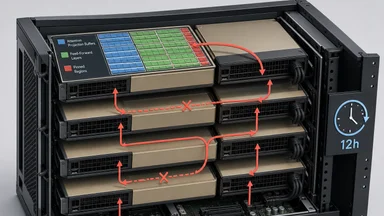
If you join a machine learning team expecting to spend your days tweaking loss functions and chasing state-of-the-art benchmarks, you will be disappointed. The infrastructure team does not care about your F1 score. They care about GPU utilization rates, queue wait times, and whether the cluster can survive a spot instance preemption without losing twelve hours of training. At scale, access to compute is the binding constraint, not model accuracy. The best models never train if the cluster is idle.
The Infrastructure Team Doesn't Care About Your F1 Score
Infrastructure engineers optimize for throughput, not precision. At OpenAI, researchers spent weeks squeezing an extra percentage point of accuracy out of GPT-3 by adjusting learning rate schedules and data mixing ratios. The infrastructure team would rather run three experiments in parallel at slightly lower accuracy than one experiment at peak accuracy. The reasoning is simple: cluster time is expensive. A single training run on a large language model can cost hundreds of thousands of dollars. Every hour the cluster sits idle is money burned. GPU utilization rates are the north star metric for infrastructure teams. If your GPUs are running at 60% utilization, you are wasting 40% of your compute budget. The team will reconfigure job scheduling, adjust batch sizes, and tune data pipelines to push that number higher. They will preempt your job if a higher-priority experiment comes in. They will ask you to use mixed precision training because it halves memory usage and speeds up throughput. Model accuracy is a research problem; GPU utilization is an infrastructure problem. The real bottleneck is cluster access. Even at companies with thousands of GPUs, demand outstrips supply. Researchers wait in queues for hours or days. The infrastructure team controls the queue. They decide which jobs run first, how many GPUs each job gets, and when to preempt low-priority work. This gives them enormous leverage. A researcher with a brilliant idea cannot execute without cluster time. The infrastructure team becomes the gatekeeper of innovation.
Scheduling jobs beats tuning hyperparameters. A well-designed scheduler can double the throughput of a cluster without adding a single GPU. Infrastructure teams invest heavily in custom schedulers that understand job dependencies, preemption costs, and resource fragmentation. They trade off precision for utilization. A job that uses 90% of GPU memory might leave 10% idle; the scheduler will pack two smaller jobs onto that GPU to improve utilization, even if each job runs slower. The aggregate throughput is higher, and that is what matters. Tradeoff: throughput over precision. This is the defining decision of training infrastructure. Every optimization that improves cluster utilization — larger batch sizes, aggressive checkpointing, dynamic resource allocation — comes at some cost to model accuracy. The infrastructure team accepts that cost because the alternative is worse: a cluster that runs at 40% utilization produces less science overall than a cluster at 90% utilization, even if each individual experiment is slightly less accurate.
Why the Best ML Engineers Become Infra Engineers
Training at scale demands systems thinking. A researcher who can write a beautiful PyTorch model but cannot debug a NCCL timeout will struggle to train on more than one GPU. The best ML engineers quickly realize that the hard problems are not in the model architecture but in the infrastructure. They learn to reason about network bandwidth, memory bandwidth, and data loading bottlenecks. They become experts in distributed training frameworks like DeepSpeed and FSDP. They stop caring about loss curve smoothness and start caring about job completion rates.
Consider the case of a major LLM provider whose deployment infrastructure had a security blind spot. In 2025, researchers discovered systemic vulnerabilities that let them bypass safety guardrails across nearly all major LLMs. The vulnerabilities were not in the model weights — they were in the deployment infrastructure: prompt injection, side-channel attacks, and insecure API endpoints. The infrastructure team had optimized for latency and throughput, not security. The result: models that could be tricked into producing dangerous instructions. This is a cautionary tale for teams that prioritize cluster access over everything else. (For more on this, see our related article on secure LLM deployment at /articles/secure-llm-deployment.)
The career arc from researcher to pipeline builder is well established. Early in their career, an ML engineer might focus on model architecture and accuracy. But as they work on larger systems, they realize that the most impactful work is in the infrastructure. They start building data pipelines, writing custom operators, and optimizing communication collectives. They attend infrastructure conferences instead of NeurIPS. They become the person who can diagnose a CUDA out-of-memory error in seconds. The reward is ownership of the compute fabric — the ability to decide how thousands of GPUs are used. At a company like Meta or Google, the infrastructure team for training systems is one of the most influential groups. They set the roadmap for hardware procurement, software stack, and resource allocation. They work with hardware vendors to prototype next-generation accelerators. They write the frameworks that every research team depends on. The tradeoff is that they rarely publish papers. Their impact is measured in utilization percentages and cost savings, not citation counts.
The Hidden Economics of Inference Clusters
Inference cost dwarfs training cost at scale. Training a large language model might cost $10 million once. Running inference for millions of users costs $10 million every few months. Infrastructure teams that focus solely on training efficiency are missing the bigger picture. Inference clusters have their own economics, and they are brutal. Every millisecond of latency adds to the cost. Every user query consumes GPU cycles that could be used for something else.
Latency SLAs shape architecture choices. If your model must respond in under 200 milliseconds, you cannot use the same batching strategies that work well for training. You need to balance batch size against latency. Larger batches improve throughput but increase response time. Infrastructure teams use dynamic batching and continuous batching to maximize throughput without violating latency constraints. They trade off model accuracy for speed — using quantization to reduce model size, even if it degrades output quality. Batching and quantization are the real optimizations. A model that uses FP16 inference might be twice as fast as one using FP32, with negligible accuracy loss. A model quantized to INT8 might be four times faster with a small accuracy drop. Infrastructure teams measure the tradeoff carefully. They run A/B tests to see if users notice the difference. Often, they do not. The cost savings are substantial enough to justify the accuracy loss.
Model accuracy degrades under load constraints. When inference clusters are overloaded, the infrastructure team has to make choices. They can drop requests, queue them, or serve a smaller model. They often choose to serve a smaller model that is faster but less accurate. This is invisible to users — they get a response, but it might be less helpful. The infrastructure team accepts this because the alternative is a timeout or error. The tradeoff is response time versus output quality, and response time usually wins.
Another example: at a large e-commerce company, the inference cluster for product recommendation models was struggling with peak holiday traffic. The infrastructure team deployed a quantized version of the model that was 3x faster but had a 2% drop in recommendation accuracy. A/B testing showed no significant change in user engagement, so the team made the quantized model the default, saving the company millions in GPU costs during the holiday season.
How Big Tech Teams Actually Optimize
FAANG teams prioritize cluster utilization rates above almost everything else. At Google, the Borg scheduler packs jobs onto machines to maximize utilization, preempting lower-priority jobs when higher-priority ones arrive. At Meta, the training infrastructure team uses a custom scheduler that understands the topology of the cluster — which GPUs are connected by NVLink, which are on the same node, which are across the network. They optimize for job completion time by minimizing communication overhead.
Preemption and spot instances save millions. Cloud providers offer spot instances at a fraction of the cost of on-demand instances, but they can be reclaimed at any time. Infrastructure teams design training pipelines that can handle preemption gracefully. They checkpoint frequently, save optimizer state, and restart from the last checkpoint. They use elastic training frameworks that can adapt to changing cluster size. The cost savings are enormous — some estimates put the savings at 60-80% compared to on-demand pricing. For example, a mid-size AI startup reduced its training costs by 70% by switching to spot instances for all non-critical training jobs, using a custom preemption handler that saved checkpoints every 10 minutes.
Custom schedulers beat off-the-shelf solutions. Kubernetes is great for microservices, but it is not designed for GPU-intensive training jobs. Big tech teams build their own schedulers that understand GPU affinity, memory topology, and job dependencies. These schedulers can pack jobs more densely, reduce fragmentation, and improve utilization by 10-20% compared to generic schedulers. Research on job queuing strategies from a top university shows that intelligent scheduling can reduce average queue wait time by 30% without sacrificing fairness.
Metrics: queue wait time, GPU idle time. Infrastructure teams monitor these metrics obsessively. A queue wait time of more than a few hours is a crisis. GPU idle time of more than 5% is a waste. They build dashboards that show utilization by cluster, by job, by user. They analyze patterns to predict demand and adjust resource allocation. They run capacity planning models to decide when to buy more GPUs. The goal is to keep the cluster as busy as possible without making users wait too long.
The Craft of Building Training Pipelines
Data loading is the silent killer. A training job that spends 30% of its time waiting for data is wasting 30% of its GPU budget. Infrastructure teams invest heavily in data loading pipelines — using high-throughput storage systems like Alluxio, prefetching data, and using fast interconnects like NVMe. They profile the data pipeline to find bottlenecks. They use data compression and sharding to reduce I/O. The difference between a well-optimized data pipeline and a naive one can be a 2x speedup in training time. For instance, one team at a large social media company replaced their HDFS-based data loader with a custom pipeline using NVMe SSDs and data prefetching, cutting data loading time from 40% of total training time to just 10%.
Checkpointing strategies prevent wasted runs. Training runs can fail for many reasons — hardware failures, software bugs, network issues. Without checkpointing, a failure means losing hours or days of work. Infrastructure teams implement checkpointing at regular intervals, saving model weights and optimizer state. They use asynchronous checkpointing to avoid blocking training. They store checkpoints in durable storage so they can resume on a different machine. The tradeoff is storage cost and I/O overhead, but the cost of losing a training run is far higher. A common pattern is to checkpoint every 1000 steps, and in case of failure, resume from the latest checkpoint. Some teams also use incremental checkpointing that saves only the changed parameters, reducing I/O overhead by up to 50%.
Distributed training requires topology awareness. When training across multiple GPUs, the communication pattern matters. GPUs on the same node communicate via NVLink, which is fast. GPUs across nodes communicate via network, which is slower. Infrastructure teams design training pipelines that minimize cross-node communication. They use hierarchical all-reduce algorithms that aggregate gradients within a node before sending them across nodes. They place model layers strategically to keep communication local. This requires deep understanding of the hardware topology. For example, a team training a 175-billion-parameter model used a 3D parallelism strategy (data, tensor, and pipeline parallelism) to minimize cross-node communication, achieving 90% scaling efficiency across 1024 GPUs.
Mixed precision training halves memory usage. By using FP16 for most operations and FP32 for critical ones, infrastructure teams can train larger models on the same hardware. They use automatic mixed precision libraries like AMP in PyTorch. They tune the loss scaling to prevent underflow. The accuracy impact is often negligible, but the memory savings are substantial. A model that requires 16 GB of memory in FP32 might fit in 8 GB with mixed precision, allowing larger batch sizes and faster training. In practice, teams report that mixed precision training can increase throughput by 1.5x to 2x with no measurable accuracy loss on most tasks.
Profiling tools reveal hidden bottlenecks. Infrastructure teams use tools like NVIDIA Nsight, PyTorch Profiler, and custom tracing to understand where time is spent. They look for GPU underutilization, excessive kernel launches, and memory bandwidth limits. They optimize the model to reduce kernel launches by fusing operations. They adjust batch sizes to saturate GPU memory. They identify communication bottlenecks and reconfigure the network topology. Profiling is an ongoing process — every change to the model or infrastructure requires re-profiling. For example, a team found that a single inefficient data augmentation kernel was causing 20% GPU idle time; after rewriting it in CUDA, they recovered the lost throughput.
What You Trade for Cluster Access
You give up model architecture exploration. When you join an infrastructure team, you stop designing new attention mechanisms or activation functions. You become an expert in existing frameworks and hardware. You learn to work within the constraints of the cluster. You might never implement a paper from scratch again. The tradeoff is that your work enables hundreds of researchers to explore architectures more efficiently. You are the force multiplier, not the star player.
You stop caring about loss curve smoothness. A researcher might obsess over a spike in the loss curve. An infrastructure engineer ignores it unless it indicates a bug. They care about whether the job completes successfully and on time. They care about whether the checkpoint was saved correctly. They care about whether the next job in the queue can start promptly. The loss curve is someone else's problem.
You optimize for job completion, not eval score. Infrastructure teams measure success by how many jobs finish per day, not by the accuracy of those jobs. They celebrate when a cluster runs at 95% utilization for a week. They celebrate when a scheduler reduces average queue wait time by 20%. They celebrate when a new data loading pipeline cuts training time by 15%. The eval score is a research metric, not an infrastructure metric.
You become an expert in NCCL and CUDA errors. Infrastructure engineers spend a significant portion of their time debugging distributed training issues. NCCL timeouts, CUDA out-of-memory errors, and network failures are daily occurrences. They learn to read stack traces, interpret GPU error codes, and diagnose hardware issues. They build tools to automatically detect and recover from common failures. This expertise is invaluable but niche. It does not transfer easily to other domains.
The payoff: your models actually ship. While researchers are still iterating on architectures, infrastructure teams are running production training jobs that produce models used by millions of users. The satisfaction comes from seeing a model go from concept to deployment, knowing that the infrastructure made it possible. The tradeoffs are real, but for many engineers, the impact is worth it.
Practical Steps to Shift Your Career Arc
Learn Kubernetes and Slurm job scheduling. These are the building blocks of training infrastructure. Understand how to configure resource requests, limits, and affinities. Learn how to write custom schedulers or extend existing ones. Practice deploying a training job on a multi-node cluster. The skills are transferable across companies and cloud providers.
Profile GPU memory and network bandwidth. Use tools like nvidia-smi and nvtop to monitor GPU utilization. Learn to identify memory bottlenecks and communication overhead. Run benchmarks to measure the impact of different batch sizes and model sizes. Understand the relationship between model size, memory usage, and throughput. This knowledge is essential for optimizing training pipelines.
Build a simple training pipeline from scratch. Start with a single GPU, then scale to multiple GPUs on a single node, then to multiple nodes. Implement data loading, checkpointing, and distributed training. Use a framework like PyTorch Distributed Data Parallel or DeepSpeed. Encounter and fix the common issues — NCCL timeouts, out-of-memory errors, slow data loading. This hands-on experience is worth more than reading a hundred blog posts.
Read papers on efficient training techniques. The literature on model parallelism, pipeline parallelism, and gradient compression is rich. Papers like "Efficient Large-Scale Language Model Training on GPU Clusters" and "ZeRO: Memory Optimizations Toward Training Trillion Parameter Models" are foundational. Understand the tradeoffs each technique makes. Apply them to your own projects. The best infrastructure engineers are well-read in systems research.
Join infra teams at AI-first companies. Companies like OpenAI, Anthropic, and Cohere have infrastructure teams that are building the next generation of training systems. Smaller companies like Replicate and Together also have interesting infrastructure challenges. The interview process will test your systems knowledge, not your model architecture skills. Prepare to discuss distributed systems, performance optimization, and failure modes.